Tuesday, May 3, 2011

[Palestine] MPT Teamer Head Wound, Broken Wrists at Izbat at Tabib


The village of Izbat at Tabib is located in Area C of the West Bank in the Qalqilya district. Recently, there has been an order to begin the construction of a fence alongside the highway that borders the village that would cut the people who live there off from 40 dunams of their farmland. 

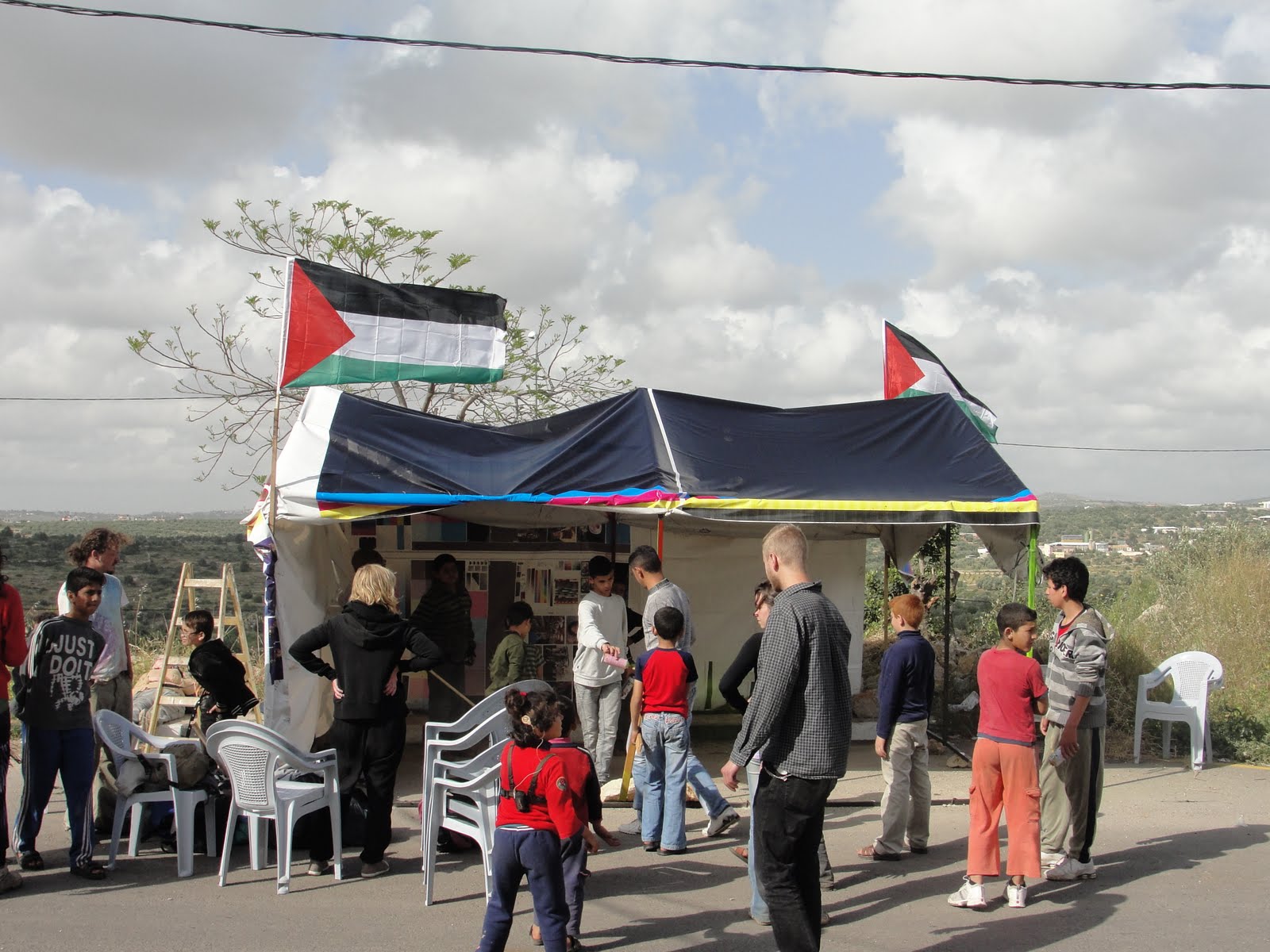
Construction was due to begin on Sunday so my teammate and I, along with other internationals, traveled to Izbat at Tabib on Friday at the request of the villagers to stay with them and be a peaceful presence.


Moussa, who has lived there all his life, welcomed MPT into his home and have us a tour as he told us about the situation there. 

Currently 32 of the 45 homes in Izbat at Tabib have demolition

orders which can be executed at any time. In addition to these current orders, one home has already been demolished in the past two years. Moussa pointed out these homes to us as we walked, including his own, which he has been trying to build for the past five years. He also showed us his grandfather’s house, the oldest in the village, which was built in 1920. Already, 45% of their land has been stolen from them.

People gathered on Saturday afternoon to erect a tent outside the entrance of the near the farm land that was being threatened. The Mayor of Izbat at Tabib and others asked the internationals to stay the night in the tent as it was expected the army would come by, if not that night, then possibly early in the morning. 

The village had taken their case against the construction to an Israeli court but had yet to hear the verdict so it was unknown whether it would begin on Sunday as previously planned or not.


Saturday night as we sat around drinking tea in the tent, military jeeps drove by a few times.

Around 8:00pm two jeeps stopped and the soldiers got out. The commanding officer instructed the soldiers not to speak with us as he questioned our reason for being there. After telling him we were enjoying tea and talking with friends and didn’t know when we would be leaving, they got in their jeeps and drove off. An hour or so later two more military keeps drove in and turned into the main street of the village, making their way through before leaving again. The rest of the night passed without incident.

The next day, Sunday, more military showed up and this time stopped to take photographs of the tent and homes in the village. When I asked the Mayor what they were doing, he said it was an intimidation tactic. They were taking photographs of all the homes and structures they were going to demolish.


It was around noon that a few military jeeps and a bulldozer arrived and parked at the head of the roads that leads to the entrance of the village, down the street from where the tent was set up. After discussing, it was decided the most important thing would be to stay near the army jeeps and the bulldozer and only have one or two internationals back at the tent. We stood there for at least an hour. The soldiers were not telling us to leave or that it was Closed Military Zone but more and more kept arriving. By the time the army began to take action against the demonstrators, we counted at least 6o soldiers including border police.


When it seemed as if the army was going to begin to move into the village it was decided that two of us would move on ahead with video cameras to record what happened. Shortly after another international and I went on ahead with our cameras, we saw and heard commotion. 

This was when I heard a scream and saw my teammate falling to the ground and then the group of soldiers honing in on the other internationals. Later on talking with my teammate, she said one of the soldiers told an international to move and when he refused, threatened to arrest him. My teammate tried to link arms with him and this is when she was thrown to the ground, which resulted in a superficial head wound and two fractured wrists, one of which needs surgery. Almost immediately after she was thrown, three of the internationals were arrested and moved out of the way.

When things had calmed down slightly around ten minutes later, I made my way through the soldiers to the back where the army medic was attending to the teammate. While I was there I also saw the three arrested internationals, one of whom had bruises covering his face from being beaten by the soldiers. The medic took care of my teammate’s immediate needs and then called the Israeli civilian ambulance. Our things, including her passport, were in our bags that were in the tent but the army refused to let us retrieve them insisting that the hospital would treat her without her passport.

However, when we switched ambulances at the Machsom checkpoint into Israel the ambulance drivers told us she needed her passport or would not be treated so while she continued onto Me’ir Hospital in Kfar Saba I returned to the village. When I got back to Izbat at Tabib the soldiers, who were well aware of the situation my teammate and I were in, told me if I tried to go back to the tent to get the passport I would be arrested. Any international who brought it to me would not be allowed to return to the tent. After around 45 minutes of waiting and trying to negotiate with the soldiers, two internationals were able to bring over our bags and I was able to then find my way into Israel to Me’ir Hospital.

At the hospital they took x-rays and determined that my teammate had fractured both wrists, one of which would heal with casting and the other which would most likely need surgery. After staying the night in the hospital and having a CT scan done the next afternoon, it was determined that she would need surgery on her left wrist.


While we were not able to be in Izbat at Tabib to witness the actions of rest of the day, as well as the following days, please visit the International Women’s Peace Service website and the International Solidarity Movement to read their accounts.

- Tali

Wednesday, April 27, 2011

[Palestine] Bedouins in the Jordan Valley & Bilin Conference 2011


The ancient and the new were viewed in the Jordan Valley as MPT members were treated to a field trip by the Sixth Annual Bil’in International Conference for Palestinian Popular Resistance.

After a short visit to Jericho we were met by a member of the Jordan Valley Solidarity Group who acted as a guide to help us understand the problems the Bedouin people are facing due to the military occupation of their ancient land and the ethnic cleansing tactics of the State of Israel. 

Two generations ago, there were 300,000 Palestinians living in the Jordan Valley. That number is now down to 56,000 – one sixth the population.

First we stopped by the dried up Al Auja spring that used to provide water to much of the southern Jordan Valley. It is dried up because Israel has drilled deep wells and stolen the water. Israel provides the water only to the illegal Israeli settlements. Only in the winter does the spring now provide a tiny bit of water. The Bedouin are forced to buy water from Israel in large tanks at exorbitant prices.

Then we moved into Ras Al Auja, a community of about 300, to see the school project that is underway. We saw the mud bricks that are being made and helped to stack some of them. Currently classes for kindergarten and preschool are held in a tent structure for around 20 students. When the mud brick school is completed, hopefully within a month, the expectation is to teach classes for children up to age eleven. The brick making is being done by volunteers, mostly women, because the men are at work. The teachers are also volunteer women. We were privileged to meet two of them.
The school is being built of mud brick because that makes it easy to rebuild. Since the majority of the Jordan Valley is in Area C, under full Israeli control, the Bedouin people cannot get permits to build any structures, not even homes. In the days when the Bedouin roamed about the Jordan Valley they lived in tents as we all would imagine. Today Israel is enforcing containment and preventing them from moving about, particularly across the border into Jordan. 

For centuries these man-made borders have meant nothing to the Bedouin. They have migrated with the seasons and availability of resources at will and have had no particular national allegiance. Now that Israel is forcing them to be more stationary, it would make sense for them to build houses--but without permits there is risk that anything they built would be destroyed by the Israeli army as has happened all over the West Bank and Gaza. The homes we observed were made of tenting materials: burlap, canvas, sac cloth and plastic tarps, corrugated metal, screening, dried vegetation such as woven reeds, twigs, etc.


The finale of our visit was being served lunch in the Center of the Jordan Valley Solidarity Group. The Jordan Valley Solidarity Group is a grassroots movement of the indigenous people with the support of some internationals, particularly from Great Britton. This Center is in a building thought to be the oldest building in the Jordan Valley, dating back the Ottoman era. It has been rebuilt over time. It is made of stone, mud bricks, metal and wood framing. While quite primitive it is much more substantial than most structures surrounding it in the community. It has a sink with running water where they cook and wash dishes, a primitive toilet, fire places for heat and cooking. There is little furniture, most seating is made of stone and mud benches covered with burlap or not. There is hope that Israel will respect the ancient quality of the Center and not destroy it as they have so many other buildings in the valley, especially schools.

In the near distance, as we stood at the building site of the school in Ras Al Auja, we could see two illegal settlement farms that exist on the stolen property of the Palestinians, their land, their water. Many of the Bedouin are forced to work on the settlement farms because they do not have water to do their own farming and they are not allowed to graze their sheep and goats near the settlements, under threat of stiff fines. We are told they work for $10-$20 a day. Many Palestinian children are also working on these settlement farms. The lack of schools in the Jordan Valley is greatly caused by the division created by the military occupation regulations, which make it the Palestinian Authority’s responsibility to provide the schools but denies the permits or land to do so. Many Bedouin children must travel long distances by bus, through military checkpoints where they are frequently harassed by Israeli soldiers, into the few Palestinian villages for school. These schools are overcrowded and it is difficult for the Bedouin children to fit in due to the very different lifestyle they lead. Many of the children drop out of school and go to work, knowing that even if they complete their education they are likely to have to work on the settlement farms due to the severe human rights violations created by the only nation in the world permitted to ignore all Geneva Convention International law for occupying countries and protected from all UN resolutions by USA vetoes.

Tuesday, April 26, 2011

[Palestine] Prison as a Weapon Against the Nonviolent Resistance


As mentioned, it was wonderful to see Abdullah Abu Rameh at the conference after being released from his 16 month imprisonment this April. Not only Abdullah, but another citizen of Bil’in, Adeeb Abu Rahmeh, had just been released in December after spending 18 months in Ofer Prison. Both are well known and respected in the community for their nonviolent resistance against the Occupation.

The lawyer that represented Abdullah Abu Rahmeh gave a talk on the strategies the Israeli military uses against Palestinians. She said that the prisons are the only real weapon Israel has against the Palestinian nonviolent movement. 

The tactics used, often begin with the minors of the villages. Unlike international law which recognizes a minor as anyone under the age of 18, Israel considers a minor in the West Bank to be anyone under the age of 16. Often the soldiers will come to the homes of minors in the middle of the night to handcuff and arrest them at gunpoint. The children are then taken to a remote location and since it is against the law to interrogate them in middle of the night, they are forced to stay awake until morning when they are taken to the police station.

They are interrogated after being kept awake all night, denied food, water, use of the bathroom, being blindfolded and held at gunpoint. Then they are asked questions about their own activities at the demonstrations as well as the activities of the suspected leaders of the popular resistance movement. If the children acknowledge to throwing stones at the Wall in the past, this nonviolent act is charged as a criminal offense and they can be put in jail for weeks. The court refuses to dismiss any information given by these minors because they have given it “willingly”. In the recent trial of Abdullah Abu Rahmeh, the judge actually stated that there was no scientific evidence that these children were traumatized.

Another tactic of the prison system is the strict regulations around visiting rights. Under international law, prisoners must be held in the occupied land. This means, Palestinians prisoners should not be taken to prisons inside Israel. Both Abdullah and Adeeb spent their time in prison at Ofer Military Base. While Ofer Military Base is technically inside the West Bank, you need an Israeli Permit to visit it, which is the same for most prisons in Palestine.

A woman attending the conference from the European parliament asked why she was denied permission to visit and tour the prisons and if there was a way around this. The lawyer said that these Palestinians prisoners, such as Abdullah and Adeeb, are considered “security prisoners” and only first degree family members and lawyers are allowed entry to see them. The Red Cross is allowed in to monitor and view the prison conditions, but their reports are not accessible.
As this lawyer said, a democracy is only as good as its prisons.

*Photo by Hamde Abu Rahme of Adeeb Abu Rahme after his release from prison

Thursday, November 4, 2010

[Jaurez] MPT accompanies Mass at the border


The Mass at the border has become a tradition, hundreds of people come together to pray on November 2nd (all souls day) for those who have lost their lives trying to cross the border. It is a most unique set-up because we may be celebrating together yet we are separated by a 10 foot high fence. There are those who come from the diocese of Las Cruces, and from El Paso on the USA side and then all the people from Juarez on the Mexican side.


Bishop Ricardo Ramirez started his homily speaking of the beauty of being together in the desert, and feeling the warmth of the rays of the sun. He said that in looking around we could see the fence that separated us but we could also see and feel the faith of the people that united us. We could also see the names on white crosses symbolizing those who have lost their lives.

Children participated, holding white balloons. They all released them together at the end of mass.

This year we also included all the victims that have lost their lives because of violence. We sang bi-lingual hymns and prayed as one. There was a prayerful festive atmosphere in spite of the border patrol being present. We are all one longing for peace.

Sunday, October 31, 2010

[Palestine] Creative Play in Palestine


For the last 6 years the village of Bil’in has organized weekly nonviolent demonstrations protesting the Israeli separation wall which denies access to 60% of the village’s land.


MPT viewed these pictures before Friday’s scheduled protest. The play material pictured is spent ammunition that Israeli soldiers used against the demonstrators.

Sunday, July 11, 2010

[Palestine] Sheik Jarrah Observations 2011


Nearly one year ago two households consisting of eight families were forcibly evicted from their house in the Sheikh Jarrah section of East Jerusalem. On a recent visit through the neighborhood MPT noticed how some family members take refuge outside under a shade tree across the street from the house they no longer live in. The house is currently occupied by Israeli settlers.

Upon walking closer to the house, MPT’s attention was drawn to what appeared to be an interview in progress. Two older Palestinian men, heads of the evicted household were being interviewed and filmed by internationals from Japan, Norway, England and the United States.

The Palestinian man stated that the interactions with his new “neighbors” are peaceful and the situation has to remain calm, so one day he and his family will have a better chance of returning to their home. One of the men stated, “There is no need for violence, so we just have a peaceful struggle.”

The men hold onto the hope that the freeze on settlements will indeed take effect in the fall of 2010. Additionally, with an impending appeal from the Israeli High Court this fall to further investigate the eviction process, the men and several international supporters meet in solidarity every Friday to hold non-violent protests.

In last Friday’s demonstration, nine non-violent protestors were arrested. Those arrested were mainly Israeli peace activists. Click on the link below for a more recent overview of the situation, courtesy of Haaretz online publication: http://www.haaretz.com/print-edition/news/nine-arrested-in-latest-sheikh-jarrah-clash-1.301162.

Monday, June 14, 2010

[Palestine] Peaceful March Through the Old City in Hebron

Al Khahil [Hebron] is one of the oldest city in the world, dating its history back to 4,000 years. It is considered the fourth holiest city in the Muslim tradition, after Mecca, Medina and Jerusalem. The city faces constant clashes between the Muslims and the Jewish population, some very violent crimes happened in the 20th century, committed by both sides.

Al Khahil/Hebron is the only Palestinian city in which approximately 450 Jews live amidst the Palestinian majority. A Palestinian massacre of Jews occurred in 1929 and all those who survived, many of whom had been protected by their Muslim neighbors, left the city. After 1967, ten Jewish families returned in the city center, in order to preserve the Jewish presence and culture in the city which according to some radical views, belongs to the Jews.


The massacre of 29 Palestinians in the Ibrahimi Mosque in the 90s led to the so-called Hebron agreement, in which the city is divided into area H1, under Palestinian administrative control, and area H2, Israeli security control. Although geographically the city is united, and all the services are commonly provided by the Hebron Municipality; the Jewish quarter forms a separate entity in the Old City. The city is also surrounded by several settlements and separation walls.

MPT visited Hebron and participated in a very peaceful demonstration this past week. There have been violent clashes between the Israeli Occupation Forces, Israeli settlers and the local Palestinians during demonstrations.


The past demonstrations` trade mark’ was the so-called “hate march”, organized by the Jewish settlers under the protection of the Israeli Occupation Forces. Every Saturday at 3:00 PM the gate which separates the two communities would open, and approximately 100 Jewish people would march in the Old City`s market, spitting in Palestinians faces, calling them crude and ugly names, destroying shops, hitting people, and giving speeches in front of different historical sites. The message of these marches was about installing Jewish domination in all Hebron and the re-occupation of the former Jewish properties, according to the Zionist theory.

Saturday, the 12th of June, the Palestinian demonstrators, accompanied by a few international activists, organized their protest in front of the separation gate at 3:00 PM, the time of the “hate march”. Protesters gave speeches, chanted in Arabic and English, and sang songs. The Jewish settlers, who started gathering at the top of the road, and settler youth on tops of buildings were did not come out on a march or to retaliate. After a while , they left.


The demonstration continued with a “peace tour” in the beautiful Old Suk/market, but the protesters had to run not to be “soaked ” by sewage water coming from the roof of the buildings, thrown by the Jewish settlers who live above these streets. Settlers have thrown garbage, cans, bottles and dirt.


The palestinian inhabitants in
the Old City protect their
livelihood with wire fences
against the trash thrown by the
jewish settlers

The demonstration ended with the safe arrival of the protesters in front of the separation gate, where new speeches and chants were expressed. Surprisingly, a smiling happy face appeared near where 4 armed soldiers had stood and near an Israeli soldier in a tower, who apparently protested with the Palestinians, but from the other side of the gate.

After two hours of peaceful protest, MPT and all participants dispersed safely, acknowledging that no violence occurred from any of the sides involved.