Saturday, November 21, 2009

[Juarez] Summary of the Exploratory Team to Juarez - Comments from Our Hosts

During the morning we met with members of the Center for Human Rights in Juárez. This is the group that invited MPT to send an exploratory team to Juárez. At this meeting our team reported the highlights of our findings and expressed our gratitude to the Center members for their excellent work. Center members then shared final messages with us.

Here is a summary of the responses from Center members after our team report:

· The children … they are our heart …we needed more time so that you could see how the children play, how they learn, how they live AND how we love them. I want you to see that the children of Juárez are the light of our hearts.

· We start with the children. They are our future AND our present.

· Thank you for your presence. You have motivated me and helped me to learn how to be part of a team. To solve our problems we have to be serious about teamwork. Peace is for everyone. Seeing how MPT works gives me hope. We can do much more here.

· Thank you -- what you have done. You have been with people who have been in fear and terror. The proposals that you have shared are very positive. Also you help us to see how to unite together with other organizations. Our people are paralyzed with fear. The organizations are also paralyzed. The situation has been very difficult -- you have helped us to lift our spirits. We need so much. We are dealing with those who have much power and no respect for life.

· You have experience with groups of people. This has been good. You have explored our roots and the history of our people. The presence and accompaniment --- I feel that it is very powerful for the people. I like that you have opened up to see how people live, and how they you want to be with you.

· We have much work to do here to resolve our problems. As you return to the United States I hope you will share how things need to change there too: Some of the problems we face in Juarez are rooted in the United States. For example…The maquiladoras exploit our people and harm our family structure. Also the drug trade flows to the United States and weapons flow from the United States to
Juárez.

· Now very young youth collect $100 for killing a person—it’s awful to say but this has become a business. Hit men are 14 or 16 years old. This is what I fear in the Barrios –
Juárez children are being used for this terrible business. After killing they sit down and wait for the soldiers. They know they will not get jail time

· You help us to see the importance of listening. We need to listen to one another.

· Our people of Km 27 very happy that you have come. We are very disposed to receive MPT.

· The people of the First of May say they noticed us. They see we want peace and have many needs. You are very welcome --We hope that you can return!

· I would say to you thank you for you solidarity—You see clearly that not only is
Juárez filled with violence; but it is also filled with hope.

· I was quite concerned about
Juárez and the country---Until Julia said that peace was possible -- the obstacles are great. Authoritarianism is strong and things will get worse. I want to be hopeful and work hard for Juárez.

· It would be wonderful to have you in the whole city. It would be a great support. Thanks to Julia and all of you for coming.


Following this meeting we were invited to a celebration sponsored by a group of senior citizens in Juárez.  With them we enjoyed a delicious meal and we danced together. Wisely the seniors told us, singing and dancing is part of our work!


Finally we had an important meeting with two Adrian Dominican sisters (Donna and Maureen) who have dedicated their lives in service of the people of Juárez. Their love wisdom and insights touched us deeply.

Monday, November 16, 2009

[Palestine] Cactus Watering Protest at At-Tuwani

On Saturday, November 7, the Fall MPT Team went to At-Tuwani to participate in a symbolic protest of watering cactus. The cactus is an appropriate plant for a protest, as the Palestinian word for “cactus” derives from the same root as “patience”: sabra. Thus the cactus has come to represent the steadfastness and inner strength of the Palestinians, as resistance to the Israeli Occupation takes time and patience. Cacti are found all over Palestine, along highways, demarcating property boundaries, and marking the location of long-ago destroyed or abandoned villages.
Early homes of At-Tuwani
At-Tuwani is a 1,000-year-old village near Hebron in the south of Palestine. Its population of approximately 250 people consists mainly of four families. Its oldest homes are between 300-500 years old, and some of the caves are believed to date from Roman times. At-Tuwani has witnessed a “building boom” in the past year which has transformed the landscape of the village. Modern cement homes are replacing the old stone structures and caves.
New homes replacing the ancient
At-Tuwani is surrounded by the illegal Israeli settlement of Ma'on, established in 1982, and the illegal Israeli outposts of Havat Ma'on and Avi Gai. The settlement of Ma’on continues to expand, having flattened a nearby hillside, putting up 6 caravans (term for a pre-fab type trailer; this first step toward the establishment or expansion of a settlement is called an "outpost") and building new homes. Since its establishment, Ma’on has confiscated close to 400 acres of land from At-Tuwani villagers.
Caravans expanding the illegal settlement of Ma'on
In 2004, after 20 years of enduring violence and harassment from the settlers, At-Tuwani invited Christian Peacemaker Teams (CPT) and the Italian peace group Operation Dove to serve as a permanent international presence in the village The internationals spend their days monitoring Palestinian children walking near the settlements to and from school, accompanying the village farmers and shepherds in their fields where they are subject to assault by extremist settlers, and being a presence as the villagers improve the infrastructure of their community.

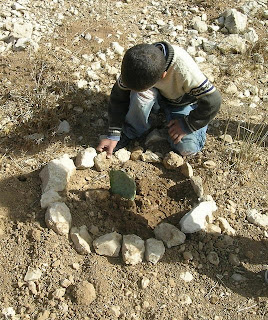
Last summer the settlers destroyed the village’s wheat crop (crops and farm machinery are regularly destroyed by the settlers) and erected a fence, confiscating one-fifth of the area. Instead of replanting wheat, the villagers planted cactus along the fence to occupy the land. Each week, as a form of protest, internationals join the women and children of the village in watering the cacti “pads,” using soda bottles filled with water carted down to the field in a wheelbarrow. Other internationals stand watch with cameras to document any military or settler interference. It’s a small action, designed for visibility, but bears testimony to the steadfastness of the Palestinians.

The men do not join in the protest for fear of arrest. At a recent village protest against a demolition order for one of the village homes, soldiers randomly arrested one of the men who was fined 20,000 shekels, or $5,000, an astronomical amount for the impoverished villager. The man’s family pooled their resources, villagers contributed, and one neighbor even sold his sheep and some furniture to help his friend. In addition to the fine, the man was imprisoned until his court date, which kept being postponed for several months. Because of this villager’s experience, the men are cautious about being upfront in the protests.
A young lad resets the stones around a cactus pad
At-Tuwani has one diesel generator that provides electricity for the village for four hours every night. Earlier this year former British Prime Minister Tony Blair promised the villagers they would have electricity and the villagers started building pylons to string the wires, only to receive demolition orders from the Israeli Army which confiscated materials and tools, including a truck, mechanized lift, and large spool of electrical cable.

Homes in At-Tuwani do not have running water. There is one spring-fed well that provides water for drinking and cooking, but does not provide enough water for washing. Rainwater is collected in cisterns for washing and for the animals. Because of years of drought and settler actions against their water sources (in the recent past, settlers poisoned the well with dead chickens), villagers have to buy much of their water, at prohibitive cost, from tankers that come to the village.

There is a well on a small hill not far from the cactus planting. However, even though it is on Palestinian land, the water is only for use by the illegal settlement and outposts. When villagers ask if they can have some of the water, officials tell them there’s “too little water,” not enough water for the villagers although the settlement has planted large numbers of cherry trees and rose bushes, two water-intensive crops.

In its October 2009 report, Troubled Waters: Palestinians Denied Fair Access to Water (www.amnestyusa.org/pdf/mde150272009en.pdf) Amnesty International accuses Israel of denying Palestinians the right to access adequate water by maintaining total control over the shared water resources and pursuing discriminatory policies. The report states that on average Palestinian daily water consumption (for drinking, bathing, cleaning, farming and for animals) reaches 18 1/2 gallons a day, compared with 79 ¼ gallons for the Israelis, and that some Palestinians barely get 5 ¼ gallons a day - the minimum recommended even in humanitarian emergencies. Numbering about 450,000, the residents of illegal settlements use as much or more water than the Palestinian population of some 2.3 million.

Amnesty International’s report also states that Israel denies Palestinians the right to dig wells, and has even destroyed cisterns and confiscated water tankers. In contrast, Israeli settlers who live in the West Bank in violation of international law have intensive-irrigation farms, swimming pools, and lush gardens and lawns. Amnesty International also charges that Israel uses more than 80% of the water from the Mountain Aquifer - the main source of underground water in Israel and the occupied Palestinian territories.

Thus the cactus planting and watering represent a fitting metaphor for the patience and forbearance required to live under Occupation.

Saturday, October 3, 2009

[Palestine] Clearing a Roadblock: An Example of Cooperation and Courage

The main entrance to Qaryut village is blocked
by a large earth and rock mound.

This week, two MPTers and three other internationals went to the small village of Qaryut to participate in a demonstration against the blockade of a road leading directly from the main highway to the village. The road blockade forced residents to take a much longer access route. It turned out to be much more than a demonstration. It was an example of planning, courage, cooperation and persistence.

Qaryut, a Palestinian village of 2,500, is surrounded by illegal Israeli settlements on three sides. Since 2000, sixty percent of the land around the village has been confiscated by the settlements. Recently Israeli authorities have confiscated an additional 225 acres of agricultural land to build three new roads for the settlements. This land belongs to about 150 Palestinian families living in Qaryut.

Large blocks needed the force of several strong men.

Shortly after noon men and boys, young and old, came down the road and gathered in front of the massive rock and gravel barrier. With shovels, hoes and bare hands they began to remove the road block. Five Israeli occupation force jeeps arrived and soon the whiz of tear gas bombs was heard.

Five Israeli jeeps with heavily armed soldiers arrived in an effort to control this nonviolent demonstration.

At this point about 75 of the younger demonstrators hurried across the field to block the main highway Number 60. The soldiers were forced to turn their attention to this problem, but could not use the tear gas because of its effects on motorists.


In a clever maneuver youth moved to the main highway
to block traffic.

Several stopped for midday prayer.

Meantime work on the road barrier continued and many of the young boys and older men gathered for prayer between the barrier and the Israeli soldiers who had by this time abandoned their plans of stopping the demonstration.

There were loud cheers and whistles as the first car crossed the barrier and made its way to the village.

Cheering and whistling, the crowd greeted the first car across.

Later, at a gathering in the village center, leaders of the demonstration reminded the gathering that this was the 105th time since 2000 that they had opened their road -- and they were ready to do it again!

[Palestine] Burin Tree Massacre

Settlers from the illegal Israeli settlement of Yitzar
cut down 97 olive trees.

On Monday night, September 28, a group of settlers from the illegal Israeli settlement of Yitzar, near the small Palestinian village of Burin, used chainsaws to cut down 97 olive trees belonging to a Burin village farmer. The next morning, internationals, including MPTers, were invited by villagers to come to the site. They found branches and tree limbs scattered everywhere over a 100 square yard area. The Israeli occupation forces had arrived before the internationals. The farmer whose olive trees had been cut down had contacted Israeli authorities to ask for Israeli army presence as protection against further settler violence during the time the cut down olive trees were harvested.

A crew of ten Palestinian men tried to salvage as many olives as possible. The internationals assisted these pickers. At first, the Israeli occupation forces showed no objection. However, a little later another Israeli army jeep came with a new commanding officer who told the Palestinians that the internationals must leave the area. The officer would not give a reason, but it was noted that a settler security jeep had come earlier and its passengers had talked to the commander. After some consultation the Palestinians advised the internationals that it would be best that they leave the area, but asked the internationals to return the following day, which they did.

On the first day, the Israeli military would not allow the internationals in the olive grove.

In the two days following this, the Israeli military were not present in the olive grove. MPTers and other internationals provided accompaniment and labor to the Palestinian workers as they picked and bagged perhaps 30 bags of olives from the destroyed trees. There was no further interference or harassment from settlers.

MPTers for two days picked olives from the cut down trees.

Hearty breaks were enjoyed by all.

On Saturday, October 3rd, the villagers of Burin organized a march to the field of the destroyed olive trees. About 15 internationals, including 3 MPTers, and a dozen media people accompanied the villagers. Halfway to the site, Israeli military jeeps were already in evidence and for a time prevented some of the marchers and media from crossing the highway. Leaders of the march negotiated with the soldiers so that the media and the rest of the marchers could witness the destruction in the olive grove. [The media and the internationals will show the world what illegal settlers had done.]

Israeli military jeeps blocked the passage of marchers, including media, until a compromise was negotiated by the Palestinians.

For a few minutes those in the march were allowed to pile cut branches for burning, but after about 30 minutes the Israeli occupation forces ordered the marchers out of the grove. The marchers returned to Burin feeling satisfied that they had done something to express their feelings about this sad event.


Marchers were only allowed to work a few minutes before being ordered out of the grove by the Israeli occupation forces.

It is difficult to overstate the importance of olive trees to the Palestinian people. Olives are used for light and heat, soap and wood-art, food and oil; they are the mainstay of the economy. The olive harvest is beginning now and incidents like this are not rare. Consequently, the Palestinians must make special preparations for the olive harvest and seek the presence of internationals to help protect them from settlers who try in various ways to prevent the harvest from being completed.

Saturday, September 26, 2009

[Palestine] Return to Iraq Burin

After a month recess during Ramahan, the weekly Friday protest at Iraq Burin, a small village 6 miles south of Nablus, resumed this week. Seven internationals, including 3 MPTers, were invited to be present. By noon on Friday a group of 200 or more from the region and the village gathered together in front of the village mosque.


Villagers, other Palestinians and internationals prepare to march toward the confiscated land.
All joined in in chanting and clapping.

At 12:15 the march began with flags, banners and the chanting of Arabic slogans. This was to be a peaceful, nonviolent demonstration. As the march approached the area claimed by the illegal Har Bracha Israeli settlement which was built on confiscated Palestinian land (including 25 acres of confiscated Iraq Burin land), Israeli soliders were seen across the valley and others above the hill crest.

Suddenly white clouds were seen on the ground as the Israeli Occupation Forces started shooting tear gas bombs. (For more details on Iraq Burin and the Har Bracha settlement, see an earlier MPT blog, August 22, 2009: http://mptinpalestine.blogspot.com/search?updated-max=2009-08-28T05%3A33%3A00%2B03%3A00&max-results=10

One of the group, a Palestinian woman, took the megaphone and passionately told the Israeli Occupation forces in English that the Palestinians people were there to protest that their land had been unjustly taken away and that the Israeli army had no right under international law to be there.

As some young people began to encroach more into the "off-limits"area (but Palestinian land) near the Israeli soldiers, more than 30 soldiers were visible. A total of about 30 tear gas bombs were volleyed by the Israeli soldiers at the nonviolent protesters. Protesters protected themselves by moving away from the tear gas smoke.


Tear gas bombs were fired by the Israeli army at unarmed nonviolent protestors.


However one young man who had moved ahead was hit in the head by a tear gas bomb and had to be evacuated. (It was later reported that he had a head wound requiring five stitches.) Two other individuals, including a member of the media, were overcome by tear gas and had to receive medical treatment.

Village youth carried the press agent to the ambulance for treatment from tear gas inhalation.


Ambulances were on alert for effects of the tear gas bombs - injuries or inhalation.

After about an hour, demonstration leaders called the group together and advised them to end the protest. The group slowly returned to Iraq Burin, vanquished again by overwhelming force, but satisfied that they had made a statement against the illegal occupation.

Saturday, September 19, 2009

[Palestine] Night Raid in Bil'in

On Tuesday, September 15th, MPT was called to assist with a possible invasion of Abdullah Abu Rahme's home. Abdullah is a nonviolent resistance leader in the village of Bil'in.

For three months there have been frequent raids at the home of resistance leaders. These home invasions are carried out by commando-type soldiers of the Israeli Occupation Forces. They gain entrance by jeep or by foot and climb over the gates and walls of the village homes in the middle of the night.
Armed, masked and well equipped Israeli soldiers invade Palestinian homes.

Bil'in has lost sixty-five percent of its village land to Israel for settlement construction. A nonviolent demonstration at the apartheid wall in Bil'in has been taking place for five years. At 2:00 a.m., six internationals, including three MPTers, went to the home of a nonviolent resistance leader, Abdullah Abu Rahme, and found soldiers had already invaded the home and blocked any further entrance. When international presence was noticed, the Israeli commandos radioed for reinforcements.


Israeli occupying forces barred the gate.

From behind the gate, soldiers ransacking the home could be seen and heard through the windows. Two internationals and several Palestinians scaled the fence and tried to enter the home. Other Palestinians pounded the gate and demanded entrance. MPTers called through the gate rebuking the soldiers in the yard and near the gate.


Israeli soldiers forced entry into the home.

Palestinian scaled the gate.

Those who entered the yard were blocked from entry to the home. However, one Palestinian, Mohammed Khatib, slipped in the door when the soldiers were not blocking it.

An additional twelve soldiers arrived and continued with the invasion. Many soldiers mingled inside and outside the gate and in the street.

MPTer confronted one of the invading Israeli soldiers.

Suddenly two MPTers discovered that the next door home of Abdullah's brother was also being invaded. MPTers and other internationals followed the soldiers into the home to provide protective accompaniment to the parents and three small children.

Israeli squadron leader directs the invasion of the home
where small children are present.

Children listened as the soldiers confronted their parents.

Parents and children watched while soldiers searched their home.

The frightened children clung to their mother and father. Soldiers asked the MPTers to "babysit"the children while they ransacked this home. MPTers refused this request as the mother wanted to be with her children and have MPT go with the soldiers.

Four soldiers ordered the father to open the door to every room in the home where they searched for Abdullah. In the basement, the soldiers found Palestinian flags, posters and banners, including posters with the picture of Bassem, a young Palestinian who was killed by a tear-gas bomb in March 2009. These flags and banners, used during the village demonstrations at the apartheid wall, were confiscated by the soldiers.

Soldiers confiscated posters used during the weekly Bil'in demonstration.

MPTers and other internationals interacted with the soldiers with comments such as "You are violating international law!" "This is an illegal invasion." "I am embarrassed that US tax money is being spent like this." "Go home and go to bed."

One Israeli soldier said, "I know what I am doing is illegal." Another said, "This is Israel."

By 2:45 a.m., the invasion was coming to a close. Abdullah was not found, but the Israel army will continue to harass his family and invade his home and village looking for him.

At that time, Mohammed Khatib came out of the house badly beaten with head and abdominal injuries. He was transported by ambulance to the hospital in Ramallah.

Mohammed Khatib was beaten by Israeli soldiers.

The soldiers left in several jeeps. Internationals stayed in the street to be with the accumulating crowd of villagers.

Thursday, July 30, 2009

[Palestine] East Jerusalem:Threat of Violence and Eviction

This past week MPTers spent Tuesday and Wednesday nights providing international presence at a home that is currently under an eviction order in the predominantly Arab neighborhood of Sheikh Jarrah in occupied East Jerusalem. The status of Jerusalem has been one of the most controversial issues in the Israel/Palestine conflict since both Palestinians and Israelis want the city for their capital. According to an article in Haaretz, the United States government includes Israeli settlements in East Jerusalem when calling for a freeze on settlements.

This particular home, which houses three families, has had an eviction order for 37 years and is continuously involved in court proceedings. Shortly after the Israeli occupation of East Jerusalem in 1967, an Israeli settler organization presented the owners of this home with what the Israeli Court has now proven to be falsified documents from the Ottoman Empire claiming the land. This house is one of the homes that the U.N. built along with the Jordanian government for Palestinian refugees from the 1948 war. Although the owner is not a political activist, he told MPT that this issue has affected him his whole life and he is determined to keep the home that he and his three children were born in. The family has decorated the front of the home with banners proclaiming, “We will never leave our home”.


In the past months, the eviction order deadline has become imminent and so internationals have been keeping a continuous presence since March, at the request of the family. Internationals provide support and a peaceful presence to de-escalate the continuous settler attacks and harassment. Israeli police, including undercover officers, habitually drive by the home, intensifying the fear of eviction. Since the home could be demolished at any time, the family must always be present and on alert. This house is just one of the 28 homes under the threat of eviction and demolition by Israel in the Sheikh Jarrah neighborhood. One of the homes has already been demolished.

While MPTers were present at the home, an intoxicated settler came to the house and attempted a forced entry. The owners of the house told him to stay away while internationals positioned themselves around the rest of the house to ensure that he could not enter. The settler kept asking about the signs on the home while trying to look inside. In the past, settlers have forced Palestinians from their homes in order to occupy the property. The settler eventually left.


This tent is inhabited by a family that was evicted from their home and is now harassed by settlers

A half an hour later, MPTers and other internationals were notified that the same settler had gone to a nearby tent that is now the home of a Palestinian woman who has been evicted from her house. The settler attacked the woman with a rock, hitting her over the head. An ambulance was called after she went unconscious for sometime. MPT was informed the next night that all the local hospitals and doctors refused to treat her unless she would change her story, and not speak of any settler attacking her. This woman is now suffering from internal swelling in her head, along with constant head pressure.

The first night MPTers stayed the night, a car of 3-4 young settler boys, aged 14-16, drove by at 4am, stopping in front of the house and throwing objects at the family, yelling and making obscene hand gestures. Approximately two hours later, local municipality officials stopped in front of the home to harass and intimidate the family.

The second night MPTers stayed at the house, unidentified police officers pulled up to the house, stopped, got out, and talked amongst themselves, intimidating the family.  No arrests or evictions occurred while MPT was in Sheikh Jarrah.