Sunday, May 30, 2010

[Palestine] Huwwara Community Integrated Team Location


A street in Huwwara.

The Huwwara village where MPT is located is on a major north-south 2-lane highway. This narrow asphalt road is used by Palestinians, Israeli settlers and Israeli Occupation Forces [IOF]. Huge trucks and buses pass with record speed through Huwwara. Israel allows no traffic control on this highway. This village of 5,500 people, has two very close neighbor villages. [The highway is Area C – full Israeli control, but most of the village is Area B Palestinian civil control and Israeli military control, but some is Area C..]

Since MPT arrived in the village of Huwwara it has been a major goal of teams to get to know the people of the village. Visiting the villagers has several objectives:
  • Learn to know one other in order to build mutual trust and understanding.
  • Educate people on the mission and work of MPT.
  • Encourage villagers to contact MPT when there is a problem with soldiers or settlers: home invasions, checkpoint problems, harassment of student nurses from the national nursing college in Huwwara or boys high school.
  • Learn the traditions of the village.
  • Celebrate with the village at weddings and other festive occasions.
  • Be a peaceful presence and show moral support and encouragement in this difficult and illegal situation.
Huwwara has many small shops, but most are struggling to survive. MPT has spoken with and given out MPT business cards to many of these shopkeepers. Many English-speaking shop owners have worked or visited many different states in the USA, including Hawaii. Those who worked in Kuwait before the First Gulf War also speak good English.


The Palestinian national nursing college has recently located in Huwwara.

MPT spoke with people who have advanced degrees and those who have much less education. MPTers have learned more of the village culture/traditions. This is a strict village which is not advantageous for women, but the amount of freedom women have depends also on the family norms and openness.

Villagers are very aware of events in the country and speak their minds about the occupation and their present government. Many just wish for the occupation to go away and some have a rather fine tuned analysis of the situation and are more action oriented. There are different levels of commitment to bringing change, as there are in any society.

Thursday, April 29, 2010

[Palestine] Jordan Valley 2010: Serious Water Crisis


As part of the Bil’in Conference international groups visited various Palestinian areas, including the Jordan Valley. The Jordan Valley is mainly Area C – Oslo Accords, which means total Israeli military control. (All of Palestine is under Israeli military control, but Area C more so.) It is, therefore, much easier for Israeli settlement s or military to confiscate land and control the limited water supply in this semi-desert area.

It is easy to locate the land controlled by the illegal Israeli settlements because their fields are greener with larger plants. The water for the Jordan Valley comes from the eastern aquifer. Palestinians are only allowed to dig their wells to a certain depth, while settlements continue to dig deeper and deeper which will eventually dry up the aquifer. Most Palestinians in the area have to buy water in portable tanks even though they have wells.

Some of the largest Israeli-owned fruit and vegetable plantations in the Occupied Palestinian Territory and Israel are in the Jordan Valley and owned by Carmel Agrexco. Most of these products are sent to Europe by the Carmel Agrexco, a company targeted by the boycott campaign. The confiscation of land and reduction of water for farming has forced many Palestinian farmers away from their land into jobs on settlement plantations. Working conditions on plantations are harsh. The hours are long and the pay is low.

Some Jordan Valley Palestinian villages were denied electricity and access to running water until two years ago. (Bedouin people in the area still have neither electricity nor running water.) Villagers get water irregularly, so are forced to buy water in tanks. Where homes have been demolished, villagers are building with adobe which is labor intensive, needs ample water and skilled builders.

Growing date palms can be a very profitable enterprise, but means careful planning, skill and sufficient water. MPT visited a Palestinian date palm farmer. He has been fairly successful, even though he works as a sharecropper. His home was demolished by the Israeli army at least once. His grove had sufficient water, but an expensive water pump was stolen by the Israeli army which he will have to replace.

Thursday, April 15, 2010

[Palestine] Huwwara Youth Harassed

Photo: Left - jeep with soldiers. Brown jacketed Palestinian teenagers [2 more behind the post] detained by the side of the main road through Huwwara.

Late Monday afternoon an MPTer, observed a group of 4 teenage boys, standing and quietly chatting by the side of the main road in Huwwara. A passing Israeli Occupation Forces [IOF] jeep pulled up and soldiers demanded their IDs. Three of the boys presented their IDs , one did not. An adult nearby, perhaps a relative, asked that this boy might go home for his ID. The MPTer moved closer to the jeep and inquired as to why the boys were being detained. One soldier responded that they could be dangerous. After being ordered back in the jeep to get their helmets, two soldiers with automatic weapons stood outside the jeep.

The IOF held the three boys’ IDs for some time, so the MPTer asked the soldiers why the IDs were being retained making boys wait. No response was given, but in a few minutes the IDs were returned and the 3 detained boys left. Soon the youth who had gone home for his ID returned on his bike. He handed the soldiers his ID which was returned rather quickly. All the youths' IDs were checked off a list by the jeep driver and all names were phoned in.

The MPTer stepped back and with care took pictures. A Palestinian said to be careful and there was no reason to escalate the situation. Taking pictures can help the soldiers conduct themselves better, but it can make the scene worse for the Palestinians.

There had been a harsh night raid into several homes in the Huwwara village over a week ago in which 7 teenage boys were taken by Israeli soldiers, so the youth had reason to worry when they were detained. Perhaps under pressure and from fear, those detained in the night raid may had given names of other youth, friends of theirs. Being a teenage Palestinian boy is often reason enough for arrest by the Israeli military. These teenagers did not know what the results of their detention by the IOF might be. The IOF has the free hand of a military occupier and can arrest and jail young Palestinian men.
This afternoon's incident lasted about 20 minutes and no one was arrested. It could have lasted hours with all being held in a detention center and later imprisoned with no explanation. So these Huwwara youth struck it lucky this afternoon.

Did MPT presence make a difference? It may have prevented a longer detention period or arrests.
These kinds of night raids and the arresting of teenage boys are increasing all over Palestine. There are some who think the reason for this action is to provoke violent responses from Palestinians so that there would be an excuse for very large attacks by the IOF. The responses of the Palestinians so far have been creative and non-violent. One Palestinian told an MPTer today that he does not understand that when Palestinians respond with good will and kindness to Israelis that they do not return that to them.

Tuesday, December 29, 2009

[Gaza Freedom March] American Embassy and Hunger Strike

Yesterday was an eventful day for MPT, starting with an update of the ever-changing news and events here in Cairo. Following the meeting, MPT accompanied a couple of the Gaza Freedom March organizers to the American Embassy where they were to join other Americans in requesting a meeting with the embassy. Several other delegations have had successful meetings with their embassies, most notably the French. For several days, the French have camped out at their embassy and were been joined by their ambassador and embassy staff who have stood with them in solidarity. While not expecting the same reception, the team was not prepared for what it observed.

After being turned away at two of the guarded entrances, team members arrived at the third entrance where they were joined by approximately 30 Americans. When access was denied, the Americans linked arms in groups of threes and marched to the gate where they held up their passports. Within a couple of minutes, one of the Americans was on the other side of the fence and on the ground. As she yelled for help, she was surrounded by a large group of Egyptian security personnel. MPT members decided that they would photograph and document the quickly-escalating situation. As a K-9 Unit arrived with leashed German Shepherds, MPT was able to document the situation although, at several points, they were warned not to photograph. A few minutes later, a large group of riot police arrived on the scene and barricaded those in front of the fence in a metal pen and then surrounded the Americans by forming a ring around the pen. The group then unfurled a colorful "Free Gaza" banner and began to sing.

Since this area is recessed and not too visible from the street, the team decided to continue observing from the sidewalk in front of the area where the Americans were being detained. Team members felt it was important both to see and be seen, and the sidewalk gave them a good vantage point. Almost immediately, they were ordered to move off the sidewalk by one of the security personnel who demanded that they reenter the recessed area and join the others who were being barricaded.

There were two other American women, including one who walks with a cane, who were seated on the sidewalk. Plainclothes security forces, led by a man named Mr. S., physically shoved one of the women and shouted at her. As this occurred, MPT moved in between her and the men who were shoving her and, almost immediately, a police van arrived and two MPT members found themselves ringed and barricaded by a group of policemen.

Team members remained in this position for about two hours; they were physically restrained from taking photographs.  At one point, when his supervisor was not looking, one police officer hummed along when those in the large pen began singing "We Shall Overcome." The attitude of those in charge - both uniformed and plainclothes - was another matter, however.

The team observed a young man who appeared to be of Arab ancestry shoved and screamed at by Mr. S. who then directed a group of security officers to pick the man up and hurl him to the ground. MPT members also saw a young woman of color dragging luggage behind her being shoved and pushed.

After a couple of hours, people were still being penned, but the tenor of the earlier part of the morning was much calmer. When the other MPT members arrived, they were ordered away from the area where the others were being barricaded. Crossing the street, they were met by a group of plainclothes officials, including Mr. S., who screamed at the team and then roughly pushed one team member.

The Team left wondering why a desire to visit one's embassy would prompt such a response, especially when other internationals were graciously received by their embassies?

Later that afternoon, the entire team headed to the Egyptian Journalists Syndicate for a press conference announcing the GFM hunger strike, initiated by Holocaust survivor and human rights advocate, Hedy Epstein.  Standing on the marble steps of the large building, Hedy gave a statement to the press and the world that people are fasting for an end to the siege of Gaza. There are over twenty people in Cairo fasting for an end to siege, including two members from the Michigan Peace Team.

Saturday, November 21, 2009

[Juarez] Summary of the Exploratory Team to Juarez - Comments from Our Hosts

During the morning we met with members of the Center for Human Rights in Juárez. This is the group that invited MPT to send an exploratory team to Juárez. At this meeting our team reported the highlights of our findings and expressed our gratitude to the Center members for their excellent work. Center members then shared final messages with us.

Here is a summary of the responses from Center members after our team report:

· The children … they are our heart …we needed more time so that you could see how the children play, how they learn, how they live AND how we love them. I want you to see that the children of Juárez are the light of our hearts.

· We start with the children. They are our future AND our present.

· Thank you for your presence. You have motivated me and helped me to learn how to be part of a team. To solve our problems we have to be serious about teamwork. Peace is for everyone. Seeing how MPT works gives me hope. We can do much more here.

· Thank you -- what you have done. You have been with people who have been in fear and terror. The proposals that you have shared are very positive. Also you help us to see how to unite together with other organizations. Our people are paralyzed with fear. The organizations are also paralyzed. The situation has been very difficult -- you have helped us to lift our spirits. We need so much. We are dealing with those who have much power and no respect for life.

· You have experience with groups of people. This has been good. You have explored our roots and the history of our people. The presence and accompaniment --- I feel that it is very powerful for the people. I like that you have opened up to see how people live, and how they you want to be with you.

· We have much work to do here to resolve our problems. As you return to the United States I hope you will share how things need to change there too: Some of the problems we face in Juarez are rooted in the United States. For example…The maquiladoras exploit our people and harm our family structure. Also the drug trade flows to the United States and weapons flow from the United States to
Juárez.

· Now very young youth collect $100 for killing a person—it’s awful to say but this has become a business. Hit men are 14 or 16 years old. This is what I fear in the Barrios –
Juárez children are being used for this terrible business. After killing they sit down and wait for the soldiers. They know they will not get jail time

· You help us to see the importance of listening. We need to listen to one another.

· Our people of Km 27 very happy that you have come. We are very disposed to receive MPT.

· The people of the First of May say they noticed us. They see we want peace and have many needs. You are very welcome --We hope that you can return!

· I would say to you thank you for you solidarity—You see clearly that not only is
Juárez filled with violence; but it is also filled with hope.

· I was quite concerned about
Juárez and the country---Until Julia said that peace was possible -- the obstacles are great. Authoritarianism is strong and things will get worse. I want to be hopeful and work hard for Juárez.

· It would be wonderful to have you in the whole city. It would be a great support. Thanks to Julia and all of you for coming.


Following this meeting we were invited to a celebration sponsored by a group of senior citizens in Juárez.  With them we enjoyed a delicious meal and we danced together. Wisely the seniors told us, singing and dancing is part of our work!


Finally we had an important meeting with two Adrian Dominican sisters (Donna and Maureen) who have dedicated their lives in service of the people of Juárez. Their love wisdom and insights touched us deeply.

Monday, November 16, 2009

[Palestine] Cactus Watering Protest at At-Tuwani

On Saturday, November 7, the Fall MPT Team went to At-Tuwani to participate in a symbolic protest of watering cactus. The cactus is an appropriate plant for a protest, as the Palestinian word for “cactus” derives from the same root as “patience”: sabra. Thus the cactus has come to represent the steadfastness and inner strength of the Palestinians, as resistance to the Israeli Occupation takes time and patience. Cacti are found all over Palestine, along highways, demarcating property boundaries, and marking the location of long-ago destroyed or abandoned villages.
Early homes of At-Tuwani
At-Tuwani is a 1,000-year-old village near Hebron in the south of Palestine. Its population of approximately 250 people consists mainly of four families. Its oldest homes are between 300-500 years old, and some of the caves are believed to date from Roman times. At-Tuwani has witnessed a “building boom” in the past year which has transformed the landscape of the village. Modern cement homes are replacing the old stone structures and caves.
New homes replacing the ancient
At-Tuwani is surrounded by the illegal Israeli settlement of Ma'on, established in 1982, and the illegal Israeli outposts of Havat Ma'on and Avi Gai. The settlement of Ma’on continues to expand, having flattened a nearby hillside, putting up 6 caravans (term for a pre-fab type trailer; this first step toward the establishment or expansion of a settlement is called an "outpost") and building new homes. Since its establishment, Ma’on has confiscated close to 400 acres of land from At-Tuwani villagers.
Caravans expanding the illegal settlement of Ma'on
In 2004, after 20 years of enduring violence and harassment from the settlers, At-Tuwani invited Christian Peacemaker Teams (CPT) and the Italian peace group Operation Dove to serve as a permanent international presence in the village The internationals spend their days monitoring Palestinian children walking near the settlements to and from school, accompanying the village farmers and shepherds in their fields where they are subject to assault by extremist settlers, and being a presence as the villagers improve the infrastructure of their community.

Last summer the settlers destroyed the village’s wheat crop (crops and farm machinery are regularly destroyed by the settlers) and erected a fence, confiscating one-fifth of the area. Instead of replanting wheat, the villagers planted cactus along the fence to occupy the land. Each week, as a form of protest, internationals join the women and children of the village in watering the cacti “pads,” using soda bottles filled with water carted down to the field in a wheelbarrow. Other internationals stand watch with cameras to document any military or settler interference. It’s a small action, designed for visibility, but bears testimony to the steadfastness of the Palestinians.

The men do not join in the protest for fear of arrest. At a recent village protest against a demolition order for one of the village homes, soldiers randomly arrested one of the men who was fined 20,000 shekels, or $5,000, an astronomical amount for the impoverished villager. The man’s family pooled their resources, villagers contributed, and one neighbor even sold his sheep and some furniture to help his friend. In addition to the fine, the man was imprisoned until his court date, which kept being postponed for several months. Because of this villager’s experience, the men are cautious about being upfront in the protests.
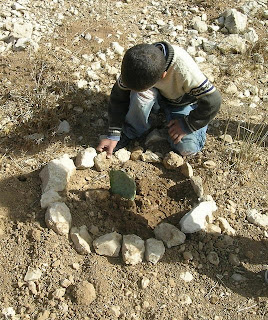
A young lad resets the stones around a cactus pad
At-Tuwani has one diesel generator that provides electricity for the village for four hours every night. Earlier this year former British Prime Minister Tony Blair promised the villagers they would have electricity and the villagers started building pylons to string the wires, only to receive demolition orders from the Israeli Army which confiscated materials and tools, including a truck, mechanized lift, and large spool of electrical cable.

Homes in At-Tuwani do not have running water. There is one spring-fed well that provides water for drinking and cooking, but does not provide enough water for washing. Rainwater is collected in cisterns for washing and for the animals. Because of years of drought and settler actions against their water sources (in the recent past, settlers poisoned the well with dead chickens), villagers have to buy much of their water, at prohibitive cost, from tankers that come to the village.

There is a well on a small hill not far from the cactus planting. However, even though it is on Palestinian land, the water is only for use by the illegal settlement and outposts. When villagers ask if they can have some of the water, officials tell them there’s “too little water,” not enough water for the villagers although the settlement has planted large numbers of cherry trees and rose bushes, two water-intensive crops.

In its October 2009 report, Troubled Waters: Palestinians Denied Fair Access to Water (www.amnestyusa.org/pdf/mde150272009en.pdf) Amnesty International accuses Israel of denying Palestinians the right to access adequate water by maintaining total control over the shared water resources and pursuing discriminatory policies. The report states that on average Palestinian daily water consumption (for drinking, bathing, cleaning, farming and for animals) reaches 18 1/2 gallons a day, compared with 79 ¼ gallons for the Israelis, and that some Palestinians barely get 5 ¼ gallons a day - the minimum recommended even in humanitarian emergencies. Numbering about 450,000, the residents of illegal settlements use as much or more water than the Palestinian population of some 2.3 million.

Amnesty International’s report also states that Israel denies Palestinians the right to dig wells, and has even destroyed cisterns and confiscated water tankers. In contrast, Israeli settlers who live in the West Bank in violation of international law have intensive-irrigation farms, swimming pools, and lush gardens and lawns. Amnesty International also charges that Israel uses more than 80% of the water from the Mountain Aquifer - the main source of underground water in Israel and the occupied Palestinian territories.

Thus the cactus planting and watering represent a fitting metaphor for the patience and forbearance required to live under Occupation.

Saturday, October 3, 2009

[Palestine] Clearing a Roadblock: An Example of Cooperation and Courage

The main entrance to Qaryut village is blocked
by a large earth and rock mound.

This week, two MPTers and three other internationals went to the small village of Qaryut to participate in a demonstration against the blockade of a road leading directly from the main highway to the village. The road blockade forced residents to take a much longer access route. It turned out to be much more than a demonstration. It was an example of planning, courage, cooperation and persistence.

Qaryut, a Palestinian village of 2,500, is surrounded by illegal Israeli settlements on three sides. Since 2000, sixty percent of the land around the village has been confiscated by the settlements. Recently Israeli authorities have confiscated an additional 225 acres of agricultural land to build three new roads for the settlements. This land belongs to about 150 Palestinian families living in Qaryut.

Large blocks needed the force of several strong men.

Shortly after noon men and boys, young and old, came down the road and gathered in front of the massive rock and gravel barrier. With shovels, hoes and bare hands they began to remove the road block. Five Israeli occupation force jeeps arrived and soon the whiz of tear gas bombs was heard.

Five Israeli jeeps with heavily armed soldiers arrived in an effort to control this nonviolent demonstration.

At this point about 75 of the younger demonstrators hurried across the field to block the main highway Number 60. The soldiers were forced to turn their attention to this problem, but could not use the tear gas because of its effects on motorists.


In a clever maneuver youth moved to the main highway
to block traffic.

Several stopped for midday prayer.

Meantime work on the road barrier continued and many of the young boys and older men gathered for prayer between the barrier and the Israeli soldiers who had by this time abandoned their plans of stopping the demonstration.

There were loud cheers and whistles as the first car crossed the barrier and made its way to the village.

Cheering and whistling, the crowd greeted the first car across.

Later, at a gathering in the village center, leaders of the demonstration reminded the gathering that this was the 105th time since 2000 that they had opened their road -- and they were ready to do it again!